Accordion Iguanas: How Marine Iguanas Shrink and Grow to Survive El Niño

Accordion Iguanas: How Marine Iguanas Shrink and Grow to Survive El Niño


Charlotte Fowler, Biology Student at Christopher Newport University 

Marine Iguanas are actually shrinking in response to the extreme environmental effects caused by El Nino storms!

El Nino is a climate pattern that describes the unusual warming of surface waters in the eastern Pacific Ocean. El Niño is the “warm phase” of a larger phenomenon called the El Niño-Southern Oscillation (ENSO). La Niña, the “cool phase” of ENSO, is a pattern that describes the unusual cooling of the region’s surface waters.
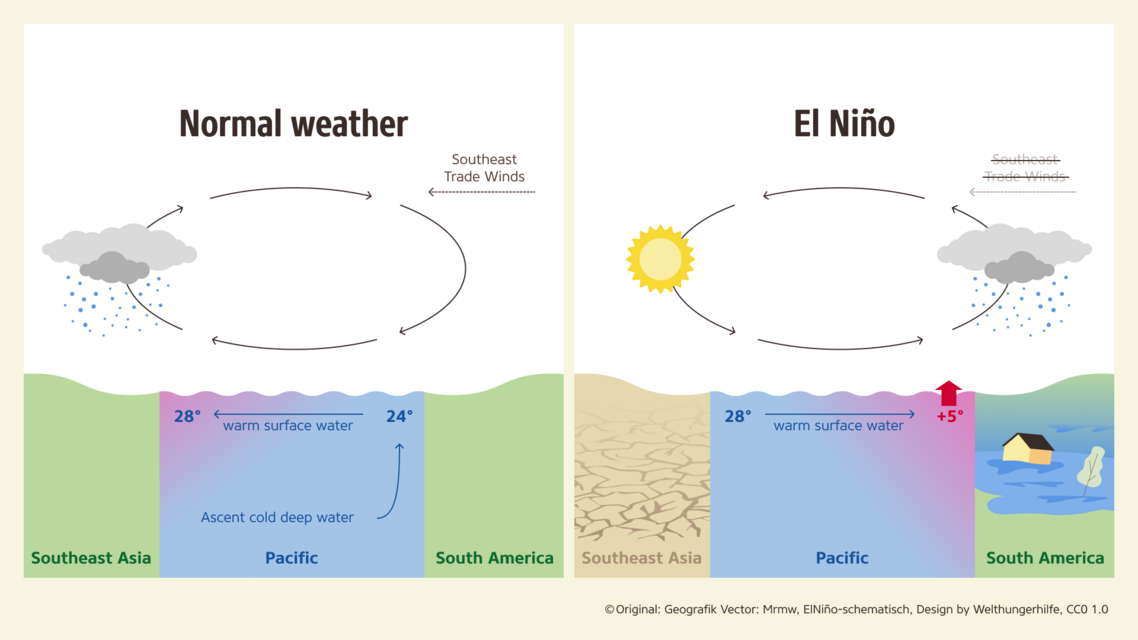


Marine Iguanas dwell in the Galapagos Islands which is located in the Pacific Ocean, close to South America. This image above shows clearly the effects of El Nino weather conditions on the water temperature and bordering land environments. Because of the warming of surface waters during the El Nino phase, marine nutrient levels drop significantly and the algae begin to die. This is the marine iguanas main food source, therefore their population becomes threatened during the El Nino weather occurrence.


Marine Iguanas have developed adaptations to survive these environmental extremities. Scientists found that Marine Iguanas began to shorten in length! This is very uncommon for any kind of vertebrate. The iguanas that shrank survived longer than larger iguanas during harsh periods because their foraging efficiency increased and their energy expenditure decreased. When you're smaller, you will expend less energy diving down deep in the water to find food, therefore, the odds of survival become greater.


This study can be compared to a similar study on astronaut bone structure: A study found that long bones of astronauts become reduced in density and length on prolonged space trips because of high stress and high cortisol levels. Similarly, the iguanas are under high stress when there is lack of food, meaning lack of exercise to retrieve food, during El Nino.


In addition to shrinking, they can grow again almost like an accordion. Body length increased again during subsequent La Niña conditions, when algal food was abundant. Changes in bone marrow metabolism enable these adult lizards to reversibly alter their length. How cool is that?!


References
El Nino | National Geographic - Education https://education.nationalgeographic.org/resource/el-nino/ 
How Marine Iguanas are Surviving Climate Change | BBC Earth https://www.youtube.com/watch?v=un2_TgSWq1c 
Wikelski, M., & Thom, C. (2000). Marine iguanas shrink to survive El Niño. Nature, 403(6765), 37–38. doi:10.1038/47396 


Comments

Popular posts from this blog

Shifting Baselines: Considering the Loss Before the Loss